SRIBD News
Application Guidelines for "Agent Technology" in the Judicial Field
On the occasion of the 10th anniversary of the Shenzhen Institute of Big Data (SRIBD) and its Industry-University-Research Forum, the Institute and the Shenzhen Intermediate People's Court jointly signed a Strategic Cooperation Agreement. The two parties will jointly conduct research on general standards for judicial artificial intelligence, technological innovation and development, and application scenario implementation, aiming to promote the modernization of the trial system and trial capacity, and fully support the high-quality development of digital courts.
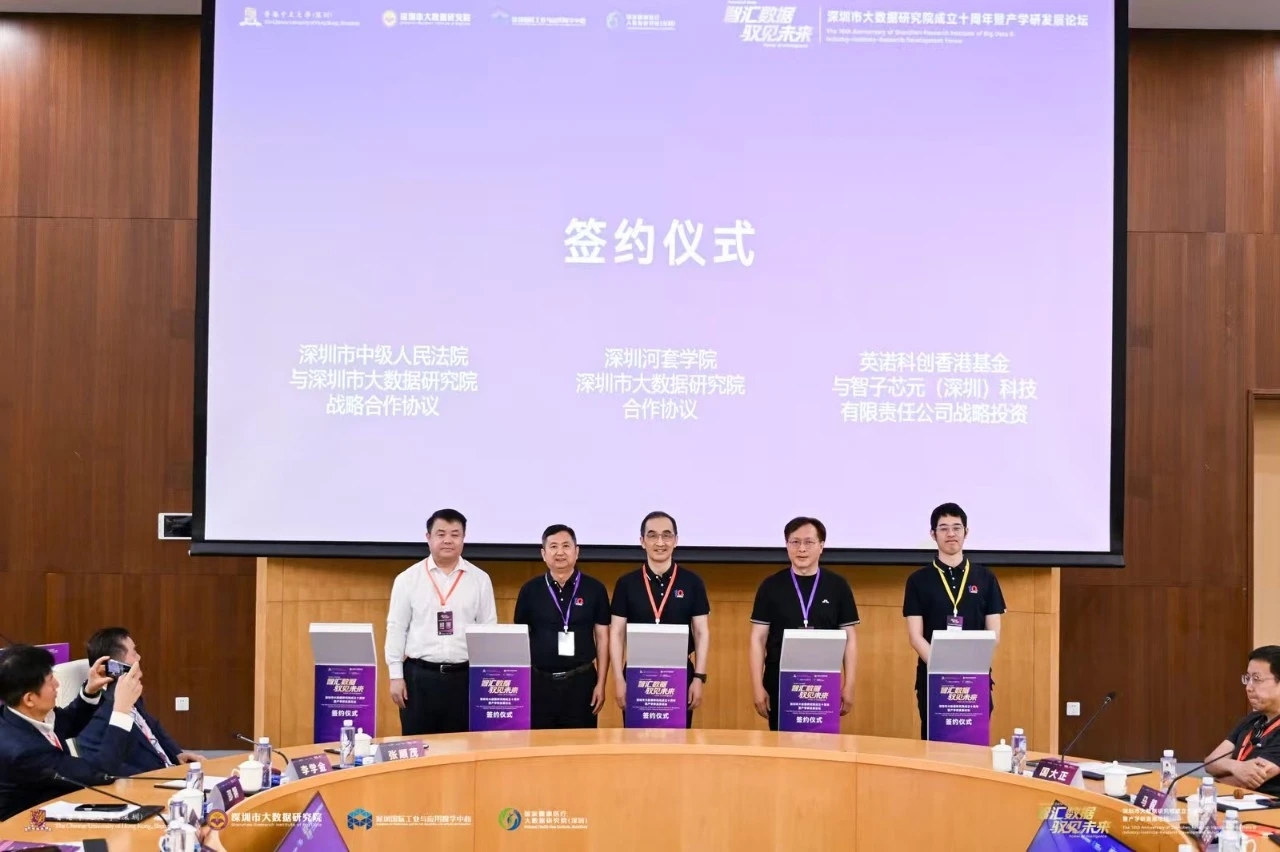
A flagship outcome of this collaboration is the Application Guidelines for Agent Technology in the Judicial Field (hereinafter referred to as the Guidelines). Jointly released by the Shenzhen Intermediate People’s Court, SRIBD, and the Institute for Internet Justice at Tsinghua University, the Guidelines offer a methodological framework for court systems deploying agent technology. They clarify operational boundaries, identify potential risks, and promote the steady, prudent, and standardized use of AI in judicial assistance.
The Guidelines cover the following three main areas:
01
Four Guiding Principles for Judicial AI Development
The Guidelines propose that the development and application of artificial intelligence technologies (including large language model technologies and agent technologies) in the judicial field should adhere to the following four basic principles:
1. Anchor to the Auxiliary Tool Position: Clarify that artificial intelligence serves as an auxiliary tool and shall not replace judges in exercising adjudicative functions.
2. Deep Integration into Trial Procedures: Promote deep integration of technology with trial processes to improve judicial efficiency and quality.
3. Concurrent Implementation of Judicial Responsibility: Throughout technological application, judicial responsibility subjects must remain clearly defined, ensuring unambiguous accountability.
4. End-to-End Data Security Assurance: Implement full life-cycle data security management to safeguard judicial data privacy and system security.
These principles are designed to guide courts at all levels in actively and prudently advancing AI applications while maintaining a clear awareness of technology's role, encouraging innovative practices with a "bold exploration, prudent application" approach, and resolutely avoiding the misconception of "machines replacing judges," ensuring that technological development consistently serves the fundamental goal of modernizing trial capacity.
02
Opportunities and Challenges of Agent Technology
Since 2026, artificial intelligence, and particularly agent technology, has entered a phase of rapid development. "Autonomous agent" technologies, represented by OpenClaw, leverage significant improvements in large language models in autonomous planning, step-by-step reasoning, task execution, and environmental interaction, greatly enhancing the efficiency and flexibility of AI in handling complex tasks and demonstrating broad application prospects. In the judicial field, autonomous agents show significant potential in batch processing of repetitive tasks, low-cost response to personalized judicial needs, and lowering the threshold for AI application development.
However, it must be clearly recognized that agent technology still has non-negligible safety risks, including risks in data security, permission control, malicious exploitation, and system protection. If applied in judicial scenarios without strict constraints, it may seriously impact procedural justice, accountability, authority management, and judicial credibility.
Specifically, agent technology in judicial applications presents four main categories of risk:
1. Authority and Responsibility Boundary Risks: Potential for improper transfer of core judicial decision-making powers.
2. Instruction Understanding Risks: Task instructions may be misinterpreted or incorrectly executed.
3. Execution Compliance Risks: Calls to capability components and process execution may deviate from statutory procedures.
4. System Security Risks: Risks such as unauthorized operations and data breaches.
The Guidelines emphasize that, in the face of the emerging paradigm of agent technology, neither outright rejection nor blind acceptance is a rational choice. How to scientifically define a safe application space and establish effective regulatory and guiding mechanisms under the dual pressure of technological promise and risk has become an urgent issue in current judicial AI development.
03
Establishing a "Negative List" for Judicial Application of Agent Technology
To balance the application potential and safety risks of agent technology, the Guidelines, building on the four R&D principles, further propose the following four-item "Negative List," which defines the safety bottom line by explicitly prohibiting certain actions:
1. Prohibition on Delegating Decision-Making Authority: Core judicial decision-making functions, such as adjudicative and approval powers, shall not be delegated to agents.
2. Prohibition on Feeding Ungoverned Data: Data that has not been cleaned, anonymized, or compliance-reviewed shall not be used to train or drive agents.
3. Prohibition on Applying Uncertified Skills: Capability components that have not undergone security assessment, functional certification, and compliance review shall not be invoked.
4. Prohibition on Bypassing Safety Guardrails: Built-in system controls, such as permission controls, audit trails, and risk-interruption mechanisms, shall not be circumvented or disabled.
This list aims to apply technological regulation with a "bottom-line thinking" approach—on one hand, reserving reasonable space for technological innovation and avoiding excessive restrictions on technical pathways; on the other hand, firmly upholding judicial ethics and safety red lines, ensuring that agent applications always operate within the rule of law.
04
Practical Foundation and Development Process
Since 2023, Shenzhen courts have taken the lead in exploring the steady integration of large language models and other AI technologies in the judicial field, developing and launching an AI-assisted trial system. Through continuous iterative upgrades, the system has to date assisted in adjudicating over 600,000 cases, achieving simultaneous improvements in judicial trial quality and efficiency, and has been upgraded to a deep-application architecture of "multi-agent secure collaboration," receiving high recognition from higher-level courts.
Drawing on this extensive practical experience—and aligned with the latest AI advancements and the unique requirements of judicial application—SRIBD and the Institute for Internet Justice at Tsinghua University, in collaboration with Shenzhen courts, compiled these Guidelines. They serve as a reference and roadmap for the standardized, safe, and effective deployment of agent technology across the judicial field.