SRIBD News
Breaking the CUDA Monopoly: Shenzhen’s Operator Technology Draws Global Attention
Editor's Note
At the beginning of 2026, the global race for AI computing power entered a new phase. NVIDIA’s CUDA ecosystem has long formed a near-monopoly, and China’s AI industry continues to face a familiar bottleneck: advanced chips are only part of the story—core software remains the real constraint.
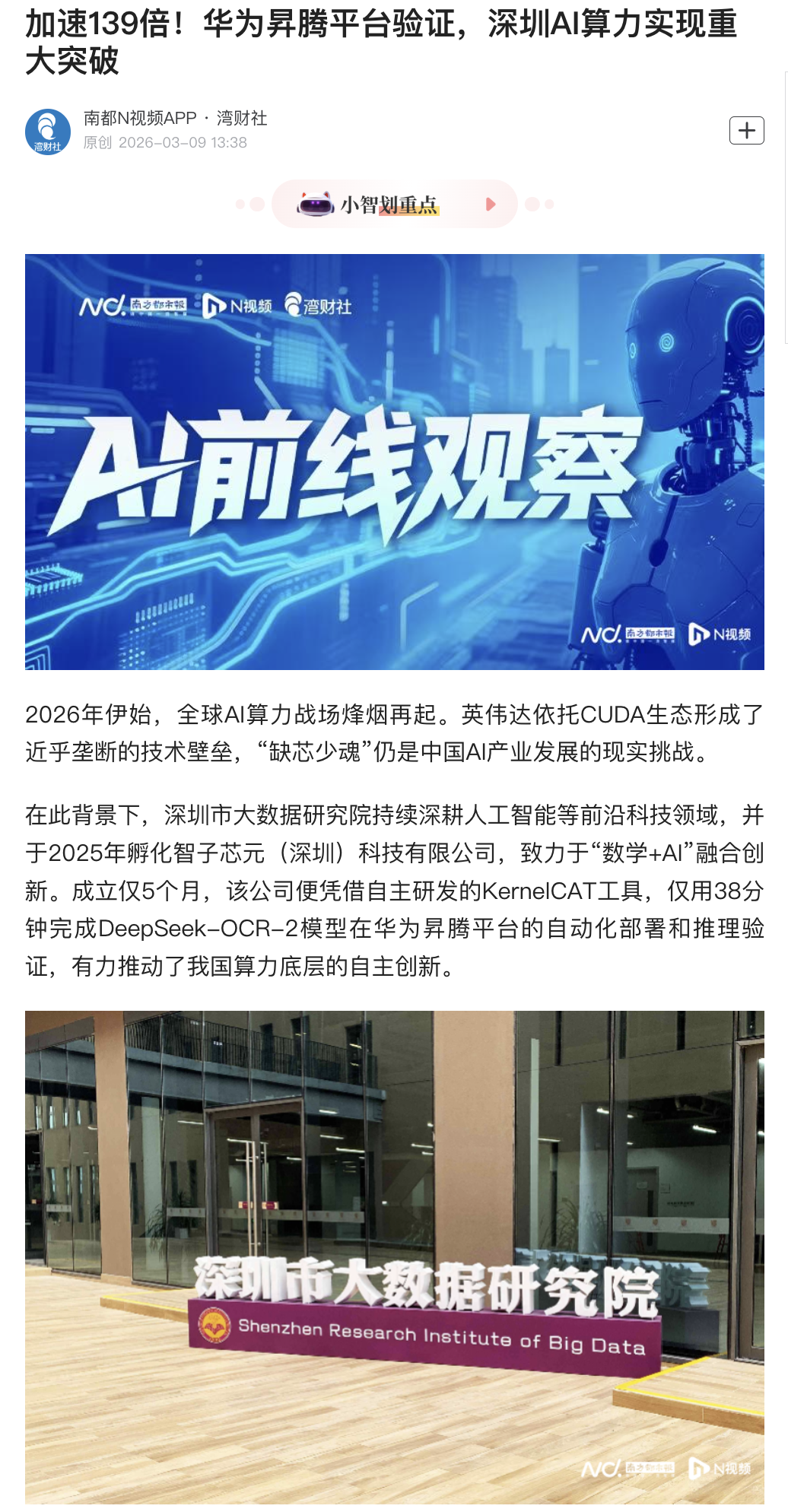
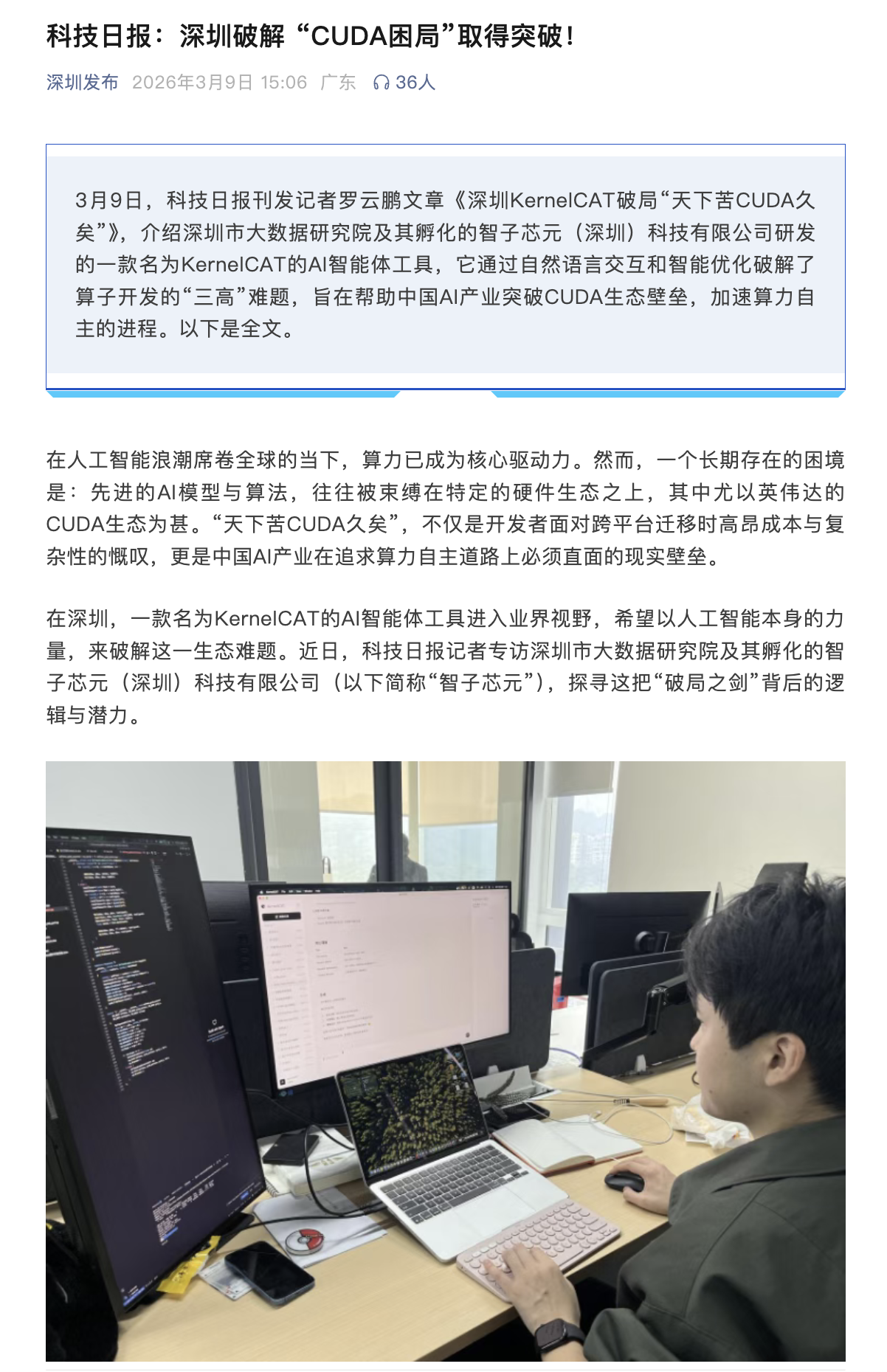
Against this backdrop, the Shenzhen Research Institute of Big Data has continued to deepen its presence in frontier fields such as artificial intelligence, and in 2025 incubated Zhizi Xinyuan (Shenzhen) Technology Co., Ltd., a startup focused on "mathematics + AI" integrated. Within just five months, the company independently developed the KernelCAT tool, which completed the automated deployment and inference validation of the DeepSeek‑OCR‑2 model on Huawei's Ascend (CANN) platform in only 38 minutes, giving a strong push to independent innovation at the foundational computing power layer.
The achievement has drawn widespread coverage from major outlets including Shenzhen Release, Science and Technology Daily, Shenzhen TV, Shenzhen Special Zone Daily, Southern Metropolis Daily, and Shenzhen Radio. What follows are key excerpts from their reporting.
The Real Bottleneck: Operators, Not Just Chips
The performance gap of domestic chips often has less to do with hardware than with software. . Domestic chips already deliver strong theoretical performance; what they lack are operators (kernels) capable of unlocking it.
Operators act as interpreters between AI algorithms and silicon. They translates high-level models into hardware-executable instructions, directly determining inference speed, energy efficiency, and cross-platform compatibility.
For a long time, to make a model run smoothly on domestic chips, top engineers had to manually write low-level code for months—like "assembling a watch while wearing handcuffs in the deep sea"—yet still struggled to reach performance limits. The industry consensus is that breaking through this bottleneck cannot rely on the traditional "handicraft workshop" model; instead, more powerful AI tools are essential.
KernelCAT represents a textbook case of how to do exactly that—delivering a 35× acceleration in end-to-end workflow efficiency.
The 38‑Minute Miracle: From "Version Hell" to Autonomous Migration
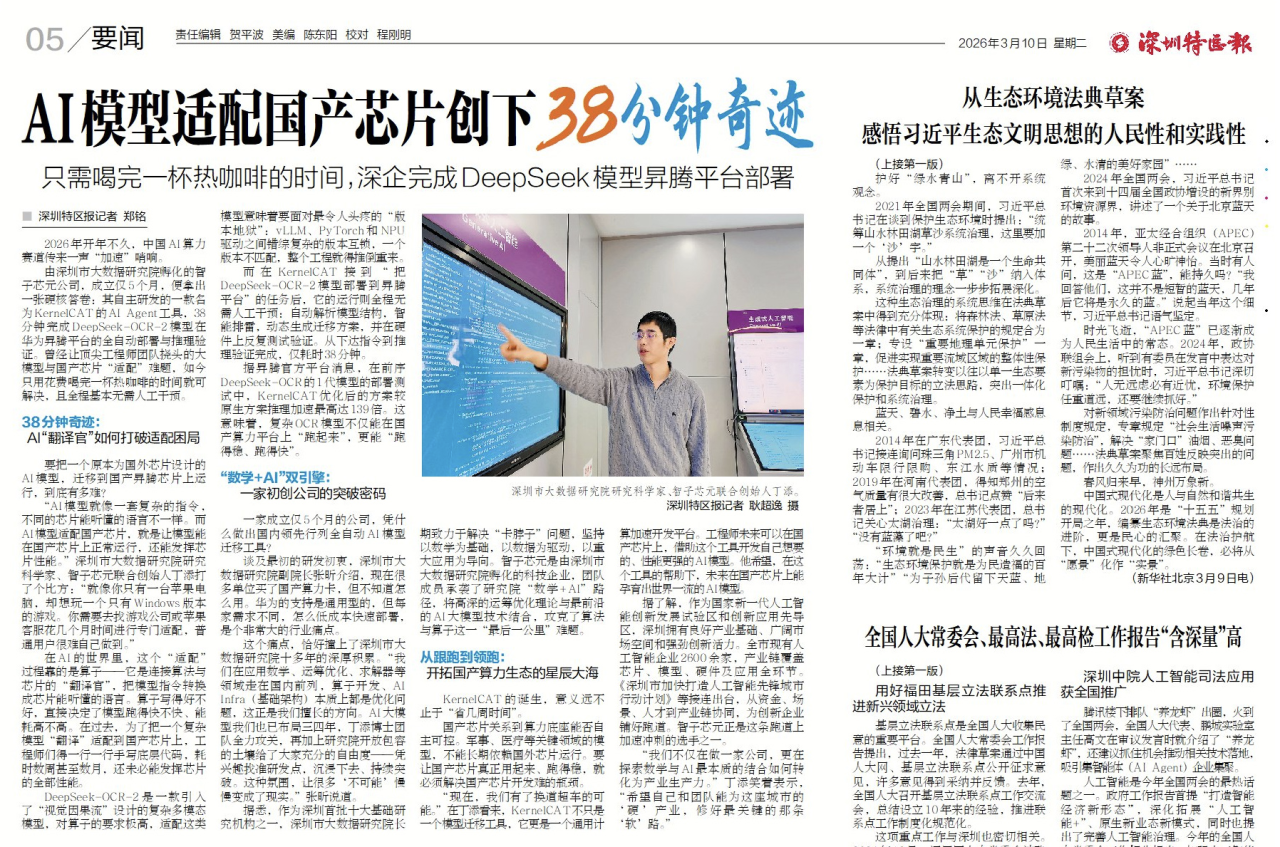
Migrating a cutting-edge model like DeepSeek-OCR-2 to Huawei’s Ascend platform used to be a nightmare. As a complex multimodal model featuring a “visual causal flow” design, DeepSeek-OCR-2 places extreme demands on operator performance.
DeepSeek‑OCR‑2 is a complex multimodal model that incorporates a "visual causal flow" design and places extremely high demands on operators. In the past, adapting such a model meant confronting the most hair‑pulling "version hell"—intricate interlocking dependencies among vLLM, PyTorch, and NPU drivers, where changing one component affected everything else.
KernelCAT turns this ordeal into an autopilot experience:
- Intelligent environment resolution:Upon startup, KernelCAT quickly took command of the battlefield. Rather than installing blindly, it precisely identified deadlock contradictions among dependent libraries through a deep understanding of the task objectives. Like an experienced bomb disposal expert, it automatically filled in missing environments and forcefully built a stable production environment amid complex version conflicts.
- Fully autonomous execution: 38 minutes. This is the total time from issuing the command to completing the migration. During those 38 minutes, developers did not need to repeatedly trial‑and‑error or stay up all night checking logs. KernelCAT automatically parsed the model structure, automatically generated a migration plan, and automatically handled errors. What previously required weeks of work by a team of experts was now accomplished in the time it takes to drink a cup of coffee.
ccording to the Ascend CANN WeChat channel, in an earlier deployment of the original DeepSeek-OCR model, KernelCAT delivered up to a 139× speedup over the native Transformers baseline—demonstrating that complex OCR models can now be deployed stably, efficiently, and reproducibly on domestic hardware.
A “Shenzhen Solution” for the Domestic Computing Ecosystem
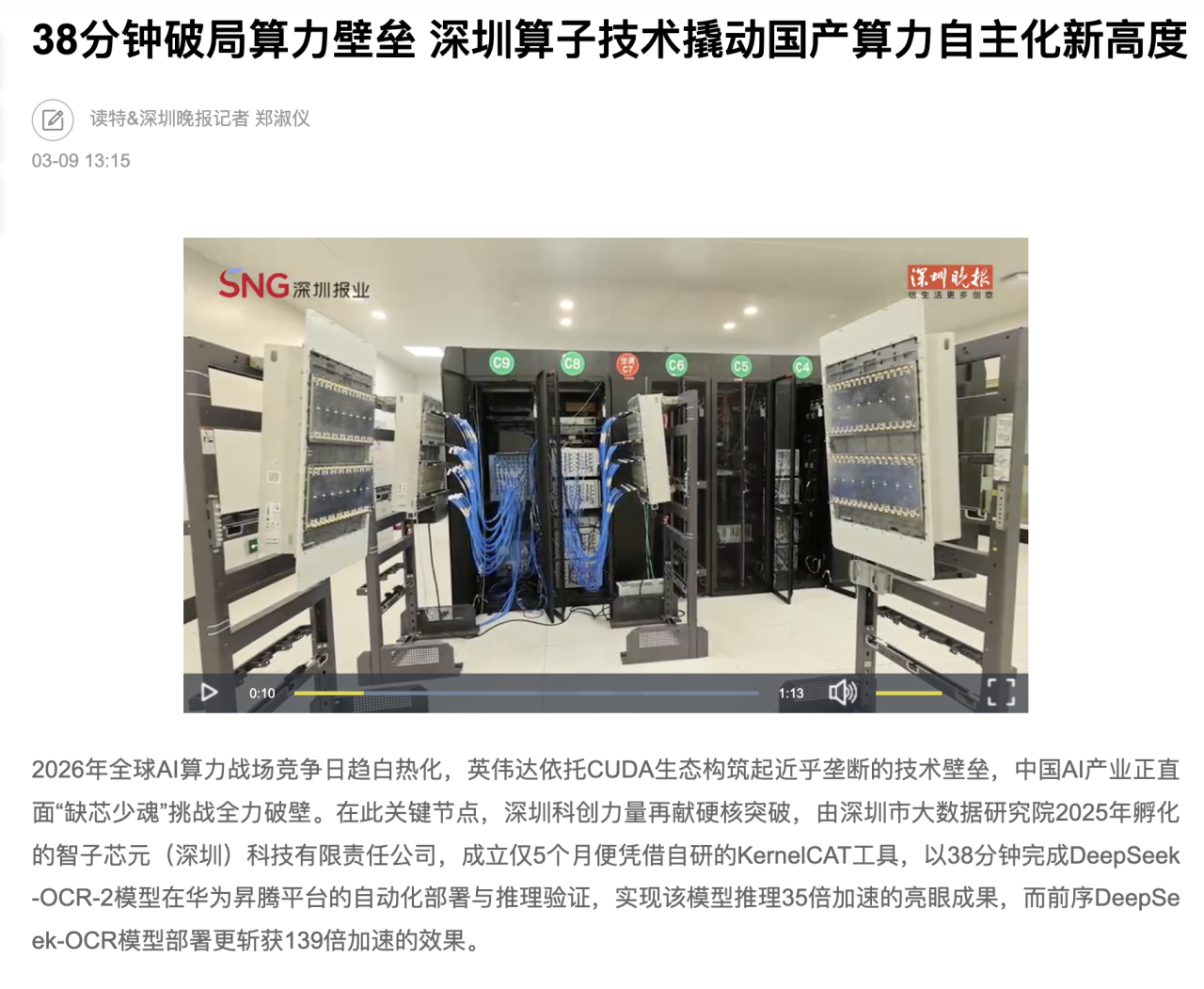
From collaborating with Huawei on key Ascend ecosystem technologies to securing strategic investment from top‑tier capital, Zhizi Xinyuan is using the "Shenzhen solution" to fill the weakest link in the domestic computing power ecosystem.
"We hope that world‑class large models can be born on domestic chips," said Ding Tian, a research scientist at the Shenzhen Institute of Big Data and co‑founder of Zhizi Xinyuan (Shenzhen) Technology Co., Ltd. He added that in the future, KernelCAT is expected to serve not only as a migration tool but also as a development accelerator for computational tasks, helping to foster new models within the domestic chip ecosystem.
Zhizi Xinyuan's innovative foundation is deeply rooted in the fusion of "mathematics + AI." Behind this lies the long‑term dedication of the Shenzhen Institute of Big Data.
In 2019, the Institute was officially designated as one of Shenzhen's fundamental research institutions. With mathematics as its foundation, data as its driver, and major applications as its orientation, it has gradually grown into a component of the national strategic scientific and technological force. The Zhizi Xinyuan team inherits the Institute's developmental DNA, combining profound operations research theory with cutting‑edge AI large‑model technology to overcome the "last‑mile" challenge between algorithms and operators.
Zhang Xin, Vice Director of the Shenzhen Research Institute of Big Data, emphasized that Shenzhen is forging a distinctive path: “With mathematics as our root and domestic computing power as our battlefield, we apply ‘AI + operations research’ to overcome bottlenecks in AI infrastructure. Wherever we see similarly promising opportunities, we will replicate this model—moving outcomes from the lab to the production line, and from Shenzhen to the rest of the country.”
The rapid growth of Zhizi Xinyuan is a vivid demonstration of Shenzhen's full‑chain innovation system of "basic research + technology development + outcome commercialization," and also a microcosm of Shenzhen's solid strength in the AI industry. Looking ahead, this breakthrough in operator technology is just the starting point for Shenzhen's underlying computing power innovation.